
Therapeutic Foraging (TF) for Dogs
Therapeutic foraging – a term that's been making the rounds in dog training circles lately. What exactly is behind it and what really matters when putting it into practice? Anja Kiefer from Hundeimpressionen shares her expertise in this guest post. Anja, thank you so much for sharing your knowledge with our community again!
Therapeutic Foraging (TF)
Therapeutic foraging, or TF for short, is so much more than just a food-based activity. It can help dogs explore at their own pace, make decisions, and experience a sense of self-efficacy.
Many foraging games – including those in the DOGLi App – share these values: autonomy, individual pace, and free choice. Classic foraging activities are equally valuable and an important part of a well-rounded enrichment routine. What sets TF apart is its specific, structured setup: a deliberately designed search environment with clear elements that simultaneously offer the dog orientation, safety, and freedom of choice.
TF is suitable for dogs of all ages – from puppies to seniors – as long as it is tailored to the individual dog. Dogs that can benefit particularly include:
anxious or reactive dogs
older, ill, or convalescing dogs
rescue dogs or "second-chance dogs" who have little trust in their environment
dogs that have rarely been allowed to make independent decisions
One important note: in TF, the search environment is carefully structured and adapted to the individual dog and their current state. And while TF is built around containers – not every container search automatically qualifies as therapeutic foraging.

The idea behind TF
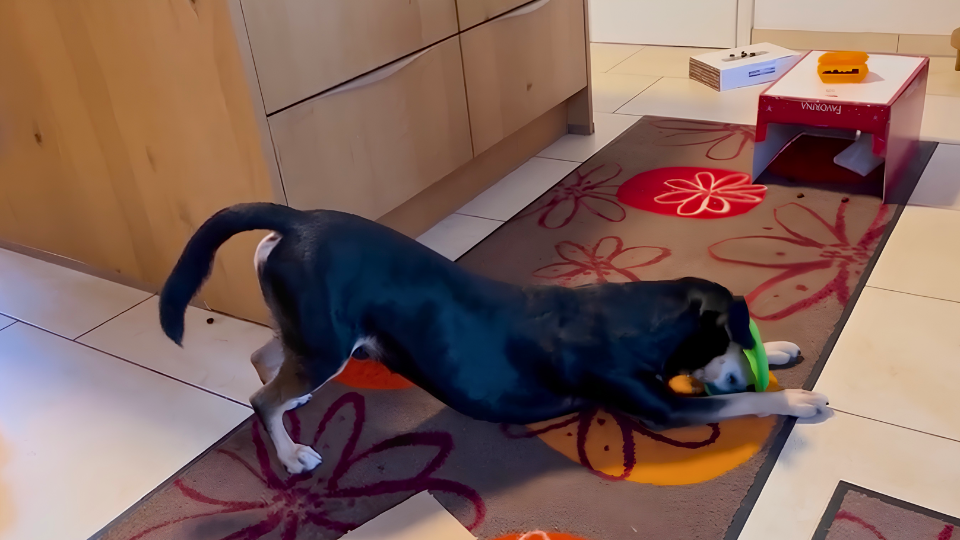
In therapeutic foraging, the dog makes decisions independently. They are free to move through the search environment at their own pace, without any guidance from their caregiver, and can disengage at any time. There is no such thing as "searching incorrectly": the dog decides for themselves in which order they visit the individual stations, which containers or search spots interest them – and which ones they may not want to engage with at all.
Whatever they choose to do, there is never a negative consequence. This experience has a lasting positive effect on wellbeing and supports resilience. And because the dog searches independently while the caregiver stays in the background, they get to experience genuine self-efficacy: finding their own way, at their own pace, in their own unique style.
What makes the search environment special?
For starters, two to three containers are usually enough – cardboard boxes work well. The containers need to be chosen carefully: the dog must be able to comfortably put their head in and take it out again. The opening needs to be large enough for this to feel easy and safe – ears should never get caught.
Some dogs may not want to put their head into a container at first. That's completely fine. In that case, the boxes can simply be placed upside down with the closed bottom facing up, or other stations can be used instead – for example, a folded towel with food scattered on top.
A key point: Food isn't only in the containers
An essential feature of TF is that there is always plenty of food scattered between the containers as well. This means the dog doesn't have to approach a container or put their head inside to get food. They can choose to simply pick up the food that is openly available between the stations. For many dogs, this is very important – it keeps the search freely accessible, low-threshold, and pressure-free.
As a rough guide for getting started: about 60% of the food openly scattered between the containers, about 40% inside the containers or other stations. This ratio can later be adapted to the individual dog and their daily form – but food between the containers always remains a fixed element.
How is this different from simply scattering food?
Scattering or tossing food is of course a perfectly valid activity – and many dogs absolutely love it. TF, however, goes one step further: the containers and search stations actively support the dog's exploratory behavior while also providing orientation. The dog isn't simply moving across an open surface, but navigating a clearly structured, safe search environment. This often creates a good balance of free exploration, orientation, freedom of choice, and a well-dosed, always manageable challenge.

Where should you start with TF?
The starting point should be as simple as possible. Starting at home is ideal – indoors, on a non-slip surface, and in a calm atmosphere. A familiar environment helps the dog feel comfortable enough to engage with TF in the first place.
Only once TF is well established and the dog understands the concept should it be introduced to other locations, such as:
in the garden
before, during, or after a walk
before and after certain everyday situations (e.g. the vet, dog training class – ideally in the parking lot if possible)
Important: TF needs to be very well established before it is used in more challenging situations. If it has been used in a stressful situation, the next TF session should always take place somewhere calm and safe again – to "recharge" its positive association.
What materials are suitable?
Good options include:
cardboard boxes or other easily accessible containers
snuffle mats
towels
various non-slip surfaces or floor targets
natural materials such as leaves, grass, or bark
Everything used in TF must be non-aversive for the dog. Familiar items are ideal at the start. New or unfamiliar materials can be interesting – but may also unsettle some dogs. If there is any uncertainty about how a dog might react to a new object or smell, it's best placed at the outer edge of the search environment. That way, the dog can decide for themselves whether they want to engage with it or not.
What food is used in TF?
The choice of food is generally up to the individual – but one rule applies: within a single TF session, only one type of food is used. This keeps the scent clear and avoids distraction through competing food smells.
A simple rule of thumb: one TF session = one type of food.
What does a good start look like?
Getting started often requires very little: a non-slip surface, two to three suitable containers, and food the dog enjoys and tolerates well.
To set up the search environment, place two to three containers with some distance between them – ideally far enough apart that the dog can walk comfortably between them. Some of the food goes into the containers, the rest is scattered openly between them (60/40). While setting up, the dog can be offered a little food in a snuffle mat – a nice way to bridge the waiting time.
Is a start signal needed?
A consistent start signal gives many dogs a helpful sense of orientation. Before beginning, the dog can be offered a treat from the hand, and a clear visual marker can be placed in front of the search area – for example, a small cone or a specific stone. This marker is used exclusively in the context of TF. If the dog wants to dive straight into the search and doesn't take the offered treat, that's perfectly fine too.
What does the caregiver do during the search?
During the search, the caregiver stays in the background. This means:
not showing the dog where food is
not correcting them
not luring them toward specific stations
not dictating how or where they should search
The dog searches independently, at their own pace, and for as long as feels right for them. The caregiver is present but holds back – and only steps in if the dog clearly turns to them for support, for example by making eye contact or signaling in another way that they want help.
How do I know if I should make it easier?
TF is meant to support the dog, not overwhelm them. Simplifying the setup or taking a break makes sense if the dog hesitates noticeably, appears tense, avoids the containers, becomes frantic, keeps checking in with the caregiver, disengages quickly, or doesn't engage at all.
In these cases, less is often more. A simpler search environment, fewer stations, more food scattered openly, or more familiar materials can make a big difference. Especially at the start: short, easy, and successful is always better than long and too difficult.
How does TF end?
TF is over when the dog is done – even if food is still left in the search environment. The dog doesn't have to find and eat everything. That too is part of the freedom of choice.
The end can be marked with a calm verbal cue and a quiet word of praise, along with a small closing ritual. If there is already an "end signal" in place, that can be used here. The search environment is then cleared away – if the occasional piece of food goes unnoticed, that's no problem at all. Many dogs enjoy finding a little surprise later on.
In summary
Therapeutic foraging is a wonderful way to give a dog freedom of choice, orientation, exploration, and a genuine sense of self-efficacy. It doesn't rely on difficulty or big challenges – it lives and breathes through a well-structured, safe, fair search environment that is adapted to the dog's individual needs and daily form.
The dog doesn't have to perform. They get to explore, search, decide, and step away whenever they choose. Anyone who builds TF thoughtfully and adapts it to their dog's needs can create a form of foraging that doesn't just keep a dog busy – it genuinely supports, relieves, and enriches.
For many dogs, TF is not just an activity. It's real enrichment. Want to see TF in action? Head over to the DOGLi App and watch the video that goes with this post!
Download the DOGLi app now and discover more than 300 enrichment ideas for your dog!


Comments